
Ulysse Nardin Freak S Howlite

Ulysse Nardin Freak S Howlite Replica Watch Price 2513-500LE-9A-HOW/3A

Ulysse Nardin Freak S Howlite

The “Cool Stone” Freak

To celebrate the 25th anniversary of the Freak collection, Ulysse Nardin continues to unveil new special editions. The latest addition, the Freak S Howlite, features a rotating hour disc inlaid with natural howlite sourced from Nova Scotia. The Freak S is powered by the in-house UN-251 self-winding movement, which incorporates two silicon oscillators inclined at a 20-degree angle, linked by a vertical differential. Beyond the “Super Freak,” the Freak S is arguably my favorite model in the collection. I have a personal fondness for dials crafted from natural stone, so this particular Freak resonates with me deeply—I’m a huge fan!

In 2026, Ulysse Nardin launched the limited-edition Freak S Howlite to commemorate the brand’s 180th anniversary and the 25th anniversary of the Freak collection. Designed specifically for the North American market, this edition is limited to just 15 pieces. The release coincides with both the brand’s 180th anniversary and the 25th anniversary of the Freak (which first debuted in 2001).

The Freak S Howlite—reference 2513-500LE-9A-HOW/3A

marries the iconic mechanical architecture of the Freak S with a natural howlite hour disc—a material used by Ulysse Nardin for the very first time. First introduced in 2022, the Freak S features dual inclined oscillators, a vertical differential, and a flying, rotating minute display; these core mechanical elements remain intact in the Freak S Howlite. The most striking change lies in the surface material: the white howlite, crisscrossed with irregular gray and dark veins, replaces the base finish found on earlier versions, ensuring that the pattern on each of the 15 timepieces is unique. The hour disc is cut from Canadian howlite and undergoes final processing in Switzerland. Furthermore, the Freak S’s distinctive method of displaying the hours has been preserved. The Freak S timepiece eschews the traditional dial-and-hand configuration; instead, it indicates minutes via a rotating movement, while hours are displayed on an independent, rotating disc. Its 45mm-diameter, 16.65mm-thick titanium case perfectly houses this architecture, which includes a deeply domed crystal.

Case and Dial
The most significant evolution in this model lies in the hour disc. It is crafted from howlite—a relatively soft white mineral characterized by natural grey-black veining—sourced from Nova Scotia, Canada. Each piece of howlite is drilled and wire-cut into thin slices, which are then ground to their final thickness, polished, and finished with a protective lacquer. During the selection process, approximately 60% of these slices are discarded based on their color, veining, and overall appearance. Because the veining pattern is unique to every piece of howlite, the background of each watch is one-of-a-kind, even though the movement layout remains constant.

The howlite component is not a static decorative dial; it functions as a disc that completes one full rotation every 12 hours, displaying the current hour beneath the operating movement. Above this, a rectangular “flying” carousel rotates once every hour, with a pointer at its tip indicating the minutes. Raised, rectangular hour markers line the outer edge of the dial. Mechanical components are stacked atop the howlite, featuring two open-worked blue oscillators positioned on either side of the central assembly, with gears visible near the lower section of the dial. online replica watches

The case, rotating bezel, locking mechanism, and case back are all crafted from grey titanium. The broad, upper surfaces of the case and lugs feature a brushed finish, while beveled, light-reflecting edges soften the otherwise sharp, angular silhouette. The bezel is defined by distinct facets, and the domed sapphire crystal rises well above it—creating a subtle, intentional distortion of the bezel’s edge when viewed from an angle. While the watch has an overall thickness of 16.65mm, its “visual thickness” is officially stated as 13.66mm. The watch weighs 116.11 grams and is water-resistant to 30 meters.

The timepiece features no crown. To set the time, the wearer must release a safety lock—marked with the word “FREAK”—positioned at 6 o’clock, and then rotate the bezel in either direction. Located beneath the lug, this safety lock serves as a visual separator between the watch case and the white strap. Through the sapphire crystal case back, one can observe the self-winding mechanism, while the titanium ring surrounding the case back bears an engraving indicating its limited-edition status. Even setting aside the depth of the exposed movement, the 45mm diameter and the prominent, high-arched crystal give the watch a substantial physical presence.

Movement
The UN-251 is an in-house, self-winding movement centered around the rotating display system characteristic of the Freak collection. Comprising 373 components and 33 jewels, the movement measures 42.15mm in diameter. Its “flying” rotating assembly completes one full revolution every 60 minutes, with the rotating component itself serving as the minute indicator. The hour indicator operates on a separate 12-hour rotating disc positioned beneath it, eliminating the need for traditional central hands. Due to this intricate rotating architecture, approximately 95% of the movement’s components are in motion. replica watches for sale

Two large oscillators are arranged at a 20-degree incline, each operating at a frequency of 2.5 Hz (18,000 vibrations per hour). Both utilize silicon balance wheels and hairsprings, while the DIAMonSIL® escapement incorporates a diamond coating over a silicon base. A vertical mechanical differential integrates the rates of the two regulating systems. This differential consists of 47 components, including six ceramic ball bearings, and is integrated into a structure that spans six gear planes—far more than the two planes typically found in conventional movement layouts.

The dual-oscillator configuration places higher demands on the winding system. The Ulysse Nardin Grinder® automatic winding system harnesses the kinetic energy from the movement of the wearer’s wrist to wind the mainspring barrel, providing a 72-hour power reserve. In addition to automatic winding, the watch can also be wound manually without using the crown: by rotating the case back counter-clockwise with both thumbs, energy is transmitted to the mainspring barrel via the base of the Grinder system. Consequently, time-setting and manual winding are performed using distinct rotating components on the best copy watch case.

The movement incorporates ten in-house silicon components, featuring a DIAMonSIL® escapement—a technology patented in 2007. The low mass and low-friction properties of silicon are particularly advantageous for a movement equipped with a dual-oscillator system and dynamic display components. Each Freak S Howlite timepiece is assembled from start to finish by a single Swiss watchmaker specializing in complex complications. The introduction of a stone-based hour-marker disc does not alter the fundamental display or regulating architecture of the UN-251 movement.

Strap
The Freak S Howlite is paired with a white rubber strap featuring a raised, ballistic-style texture. This woven pattern echoes the white hour markers, while the strap’s rectangular motifs provide a striking contrast to the irregular, organic texture of the stone. The strap tapers away from the angular titanium lugs and is accented with white stitching along its upper edges.

Clasp
The watch is fitted with a titanium folding clasp, matching the material of the case rather than introducing a different metallic finish. Robust lug attachments secure the strap to both ends of the case. The light-colored rubber creates a distinct transition between the strap and the substantial titanium case—most notably around the bezel-locking mechanism at 6 o’clock, which bears the “FREAK” signature. The underside of the strap is smooth and light gray in color, featuring an embossed brand logo near the attachment point. The Freak S Howlite (Ref. 2513-500LE-9A-HOW/3A) is an anniversary edition that retains the iconic dual-oscillator movement of the original Freak S. Its defining feature is a rotating hour disc crafted from natural howlite—a unique, stone-based element.

Technical Specifications
Case
Grey titanium case, featuring a rotating bezel, a safety lock, and a case back; domed sapphire crystal and transparent sapphire case back; 45 mm in diameter; 16.65 mm total thickness (13.66 mm visible thickness); weight of 116.11 g; water-resistant to 30 meters. Popular fake watches
Movement
Manufacture self-winding movement UN-251; flying carousel-style minute display with a rotating 12-hour disc; dual oscillators inclined at 20 degrees; 2 x 2.5 Hz (2 x 18,000 vph); silicon balance wheels and hairsprings; DIAMonSIL® escapement; vertical differential comprising 47 components with ceramic ball bearings; Grinder® automatic winding system; 373 components in total; 33 jewels; movement diameter of 42.15 mm; 72-hour power reserve.
Dial
Rotating hour disc made of natural howlite, sourced from Nova Scotia, Canada; the white stone features grey-to-black veining; includes an outer-rim scale and a movement-integrated minute display.
Strap
White rubber strap with a ballistic texture, equipped with a titanium folding clasp.
Reference Number
2513-500LE-9A-HOW/3A
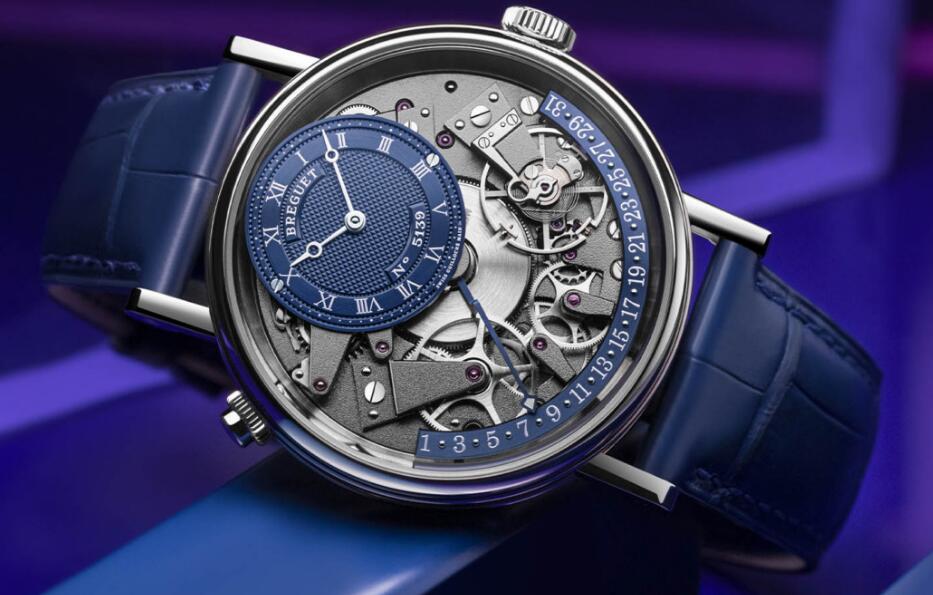
Breguet Tradition Quantième Rétrograde 7597 in blue

The latest Tradition watch in modern blue.

Vintage style fake watches review are part of the industry and have been highly sought after for about a decade. But when it comes to evoking memories of the past, few are better and more historic than the Breguet heritage. A tribute to Souscription watches of the late 18th century, the heart of the Tradition is the exposed structure of its movement. Several mechanical changes were released, the latest model being the 2020 Tradition Quantième Rétrograde 7597, and today the brand is releasing it in a new colour combination, with a white gold case and a surprisingly bold and modern (at least by the brand’s standards) blue color dial.

While Breguet often draws inspiration from vintage pocket watches to create recognizable displays of its contemporary timepieces, the Tradition collection goes deeper, or at least goes in a different direction. The Tradition watch collection was born in 2005 as a tribute to AL Breguet’s souscription pocket watches. After the French Revolution, he needed to create a new business model that would make watches easier to use while also strengthening the company’s cash flow (not very sexy, but that’s the reality behind the concept). He came up with the concept of subscription watches in 1796, an early version of mass production maintained through crowdfunding. The idea is to get a potential customer to make an initial down payment or subscription, to finance the construction of a relatively simple pocket watch with a large diameter, one hand, a simple movement and a very modest price. This, in turn, would ensure that Breguet could buy parts and build a production line to produce watches in identical batches.

The beauty of the subscription watch is its simple movement construction, which fake Breguet included in his first YTO watch in 1799. The movement is built around a central mainspring with symmetrically constructed finger bridges – balanced to echo the central wheel of the gear train. When the brand launched the Tradition collection in 2005, the idea was to show it below the dial of Breguet’s souscription watches Some original components of the movement. However, the bridges, gears, escapement and barrel are not displayed on the caseback, but are placed on top of the baseplate for viewing from the dial.

Following several different watches, such as manual winding; GMT; automatic retrograde seconds; chronograph; Quantième…a fancy French word for a date complication. But Breguet is Breguet, and it is more than a simple date window. Based on the Automatique Seconde Retrograde 7097, it shares the same basic movement with the self-winding mechanism, but without the retrograde seconds, which has been replaced by a new date function on a dome from 4 o’clock to 7 o’clock. New for this year is the Tradition Quantième Rétrograde 7597 with the addition of a blue version, echoing the Seconde Rétrograde 7097 Blue ‘Boutique Edition’ we are showing here.

The basics remain the same. 40mm high and 12.10mm 18k white gold case in typical Breguet style with thin polished bezel, finely grooved baseband and individually welded lugs with screw rods at the ends to secure the strap. The watch has sapphire crystals on both ends and is water resistant to 30 meters (who wants to see this watch underwater anyway…) For this occasion, the watch is worn on a dark blue alligator leather strap with a clasp Matching pin buckle closure. case.

The change this year is color. The movement retains its anthracite-coated hammer plates and bridges, with contrasting polished bevels, and all wheels and moving elements are rhodium-plated for contrast. The eccentric guilloche dial is made of solid gold and hand-finished on an engine-turned machine, here rendered in blue with the Roman numerals and logo in silver transfer. The open Breguet hands are also silver. The beautiful date track is also blue, and the numbers alternate between silver powder transfers and gold cabochons.

Although simple at first – the date mechanism is often considered the simplest complication – the Breguet Tradition Quantième Rétrograde 7597 features some mechanical improvements. Due to the architectural concept of this movement and its many parts, a retrograde date may be the best choice. The complications are unobtrusive and respect the symmetry of the movement. The date can be corrected quickly thanks to the screw pusher at 10 o’clock. In addition, the shape of the central date hand made of blued steel is also unique. In order to pass the balance and center wheel, it had to be shaped by hand before being heat-blued.

The back shows the automatic in-house calibre 505Q, with its real gold rotor echoing the winding quality found on earlier Perpetuelle pocket watches, however, it now rotates in a classic 360-degree rotation. The movement is modern, and despite its modern appearance, it has a reverse in-line lever escapement with silicon horns, and a Breguet hairspring, also made of silicon – both of which are antimagnetic. Operates at 3Hz with a power reserve of up to 50 hours.

TECHNICAL SPECIFICATIONS – Breguet TRADITION QUANTIÈME RÉTROGRADE 7597
Case: 40mm diameter x 12.10mm height – 18k white gold case – polished with slotted strap – welded lugs with screw bars – sapphire crystal front and case back – push-button date adjustment – 30m water resistance
Dial: 18k solid gold, blue, hand-operated engine – hour markers, Roman numerals – blued steel open Breguet hands
Movement: In-house Caliber 505Q – Automatic with gold central oscillating weight in historic movement style – 14.5″ lignes – 45 jewels – 6 position adjustment – 50 hour power reserve – reverse in-line lever escapement with silicon horns Longitudinal mechanism, Breguet silicon balance spring – 21,600 vibrations/hour – Off-centre hours and minutes, retrograde date – Movement finished in historic style with hammered bridges
Strap: Blue alligator leather strap with gold pin buckle
Reference: 7597BB/GY/9WU

Discover the Patek Philippe Aquanaut

Many people say that the Aquanaut embodies the more dynamic and positive side of copy Patek Philippe. More sporty and uninhibited than any other watch from the brand, with its unconventional rubber strap and vibrant color scheme. Where else would Patek Philippe use bright orange or army green? It has long lived in the shadow of its older brother, the Nautilus, and only recently has it really started to appreciate.

Often known for its classic, retrained designs and traditional materials, the first major shift in this trend came from Gérald Genta’s mind. Then, it would take another two decades for Patek Philippe’s in-house team to produce its own sports watch. Although it was inspired by the porthole shape, the Aquanaut was the first modern sports watch that was truly designed by the brand itself. In the last decade of the 20th century, it was designed to appeal to young Patek Philippe collectors by offering steel instead of gold, rubber instead of leather.

The Aquanaut is a watch full of paradoxes and intrigues. The first reference comes from an increasingly interesting timepiece era, neither retro nor modern, where cream tritium lumens can be found along with more modern production techniques. Their current products also remain the canvas for the brand to continue experimenting with new designs, colors and complications. Aquanaut’s many forms have evolved into something more than Nautilus’ younger, neglected sibling. With this in mind, we delved into the origin of the model and the different forms it has taken over time.

Mysterious Origin Story

Around the time Patek Philippe was considering a new copy watch, it became clear that the public was ready for the more sporty designs of the legacy brand. In fact, this is almost to be expected. However, the main problem is that Patek Philippe’s only sports products are not designed by them. Sketch by Gérald Genta with his brilliant fingerprints. So when a valued client comes to them for a durable watch that can be given to a senior officer serving in their country’s military, they know it’s time to start over with the design.

That’s at least the story Nick Foulkes tells about the origins of the Aquanaut in Patek Philippe Magazine Volume 4. Thierry Stern himself was quoted describing the origins of the brand’s second sports watch. As he puts it, it’s meant to be “something that’s wearable, not for dinner, but for action. It’s for the best officers in the military, so the design needs to remind you of something military.” The mystery client The identities of these officials, or the countries these officials served, remain unknown to the public, which perhaps only makes this origin story more intriguing.

Aquanaut referee. 5060S

Introduced in 1997, the reference model 5060A is widely regarded as the first Aquanaut. It combines a rubber strap, a steel porthole case and a checkered dial, all of which are fundamental features of the Aquanaut design. However, Aquanaut’s origin story is complicated in some ways. First off, the first Aquanauts were not actually sold as Aquanauts. Instead, they are sold as part of the popular Nautilus series. This makes sense, considering the design was intentionally derived and Patek Philippe wanted to incorporate the Aquanaut into its existing sports watch collection.

Second, the transition between the Nautilus and the typical Aquanaut as we understand it is a gradual and fuzzy transition. Input reference 5060S. This model was introduced in 1996, a year before the release of the reference 5060A. While it shares some of the features that define the Aquanaut, notably the redesigned porthole case, it’s also distinctly different in other ways, with its precious metal case, smooth dial, Roman numerals, and leather strap.

The 5060S clearly represents Patek Philippe’s first attempt to reinterpret the Nautilus design away from a one-piece bracelet. It can be found listed alongside the Nautilus 3800 in catalogues of the period, with identical dials, hands and date discs, making this lineage even more evident. The fact that it was originally offered on a leather strap rather than a rubber one may suggest that Patek Philippe originally wanted to create a more dressy Nautilus rather than the Aquanaut design we’re already familiar with. This is due to the fact that the 5060S is produced using only precious metals such as rose or gold. As a result, some collectors started referring to the 5060S as “Pre-Aquanaut.” Not exactly Nautilus, not exactly Aquanaut, but somewhere in between.

Expand the collection

referee. 4960, 5064, 5065 and 5066

One year after the referee. The 5060 was a success with existing Patek Philippe customers, and the company decided to update and expand its Aquanaut offering. The 5064, 5065 and 5066 were released, all bringing something different to the Aquanaut family. The 5064 introduced a more functional quartz movement, the 5066 was a repeat of the previous model but with an open caseback, and the 5065 was an upgraded version of the previous design.

With an E 23 SC quartz movement and a reduced diameter of 34mm, the 5064 is the entry-level Aquanaut and one of the brand’s most affordable timepieces. Contrary to popular belief, it was primarily aimed at male collectors, and the 29.5mm reference 4960 was also released in 1998 for the brand’s female audience. Due to their reduced diameter and non-mechanical movements, the 5064 and 4960 Aquanauts have largely failed to capture the attention of contemporary collectors looking back on earlier Aquanauts.

However, the reference 5066 and 5065 are probably the prototype and most desirable of the new retro Aquanauts. The 5065 took the original design from the previous year and enlarged it to 38mm, so it’s often referred to as the “giant” Aquanaut. As for the 5066, it maintains the same dimensions and movement as the previous generation. Both watches showcase their internal mechanics through a sapphire caseback, something the 5060 lacked before.

Both reference 5065 and 5066 were produced from 1998 to 2006. They share almost all design features, except for their size and movement. This period in Patek Philippe’s history is particularly interesting because it marked a shift from more traditional production methods and materials to a more modern one. Legacy of the past, such as closed casebacks and tritium dials, slowly gave way to more modern, often commercial considerations.

One area where this modernization is particularly evident is the transition from tritium to superluminescent materials. Roughly speaking, Patek Philippe used tritium from 1998 to 2004 and then Super Luminous from 2004 to 2006. Even though tritium dials have been around for longer, it is believed that Patek Philippe expanded the production of the reference in the last two years, making super luminous dials and hands actually more common than one might initially think. Distinguishing between tritium and superluminescent materials is fairly easy. The former generally produces a warmer brown patina, while the latter retains its color over time. Superluminova also has a trend towards green instead of white. These superluminova versions of the 5066 and 5065 are generally less popular than the tritium examples,

It’s worth noting that in 2004, when Patek Philippe transitioned from one material to another, some interesting component overlap may have occurred. In fact, a handful of watches are believed to combine tritium and ultra-luminous components. For example, while a 1999 watch with a tritium dial and ultra-luminous hands would obviously have service hands, the same watch from 2004 might feature these hybrid elements in a new product. Considering this coincides with a period when Patek Philippe started mass-producing components, it seems plausible that they would be more casual with the parts available in their inventory.

We also had a chance to deal with the 5066 from 2004, which had an ultra-luminous dial and tritium hands, which was even more interesting. Given that the hands are so much more delicate than the dial, it seems unlikely that swiss Patek Philippe would opt to install an ultra-luminous dial while retaining the tritium hands. In this case, the notion of a service component is even more unlikely (as we know the history of the watch), although in a limited and anecdotal way it supports the idea that tritium and superluminescent elements were sometimes combined around 2004.

Audemars Piguet-Code 11.59

Since its official launch in 2019, this year Audemars Piguet’s Code 11.59 series has added five new self-winding three-hand watches and five new self-winding chronographs.

The new model is characterized by the lacquered dial with blue, burgundy, purple and light gray and dark gray sunburst patterns, all with 41 mm white gold, rose gold or two-tone white gold and rose gold cases.

These new Audemars Piguet Code 11.59 models are equipped with a new generation of self-winding and self-winding chronograph movements released by the manufacturer in 2019. The self-winding model is equipped with a 4302 movement, an automatic movement with seconds and instant date indication, and a 22-carat oscillating weight visible through the sapphire back cover.

The self-winding chronograph model is powered by the 4401 movement, which is an integrated chronograph with a column wheel and flyback function. The chronograph can be restarted without first stopping and resetting.

dial
Because of the complicated and highly manual work required to make them, the dials in this series are all made by a single supplier. This was partly due to the choice to display the lacquered dial, which then had to accommodate a rather unusual logo.

The 12.5 mm long copy Audemars Piguet logo is made using an electroplating growth process, which is a chemical process used to achieve micro-measurement accuracy. It is applied by superimposing thin layers of 24 carats of gold on top of each other to produce a 3D effect. Although other watchmakers have also adopted this process, Audemars Piguet was the first company to use 24-carat gold in this process. This complex logo implementation took about two years to develop, partly because the “A” and “U” of the Audemars Piguet logo are very thin. More importantly, these letters are connected to each other by links about the size of a hair.

Unexpected Dimension: Crystal
As mentioned earlier, Audemars Piguet’s CODE 11.59 bezel is very thin. The reason behind this geometric shape is that the bezel needs to integrate an unusual sapphire crystal, which is also designed for this series. The inner surface of the anti-glare sapphire crystal is dome-shaped, while the outer surface is vertically curved from 6 o’clock to 12 o’clock.

This arched profile is designed to provide the best readability for the dial. Regardless of clarity, this also means that the depth, viewing angle and even light of the timepiece can play a role, because it is tilted and studied from a contrasting angle and surface. Even if the watch is not your style, it is well worth seeing for yourself-the execution of the crystal is a truly impressive design feat, very clear, even at a glance.

Specially built: internal movement
The movement of the self-winding watch and the self-winding chronograph was specially developed by the Audemars Piguet series for CODE 11.59. Like the case and dial, the development of the movement is no small feat—especially for the long-awaited self-winding chronograph model of the brand’s fans.

The chronograph model is powered by the internal calibre 4401, which is an integrated chronograph with a column wheel and flyback function. The chronograph can be restarted without first stopping and resetting. The movement has a diameter of 32 mm, and of course it also provides an hour, small seconds and date window. The movement is also equipped with a patented reset mechanism to ensure that each counter pointer is reset to zero.

In addition, it is also equipped with a vertical clutch system to prevent the hands from jumping when the chronograph is stopped or started. Audemars Piguet is keen to showcase as many 367 components and functions as possible. Parts that are usually hidden from sight, such as the so-called “dance” of the chronograph hammer when the column wheel and the chronograph are reset, can be seen through the back cover, and even the 22-carat gold pendulum is open-working.

At the same time, the self-winding movement 4302 (also with a large diameter of 32 mm) belongs to the same movement series as its chronograph cousin, but it is naturally much simpler. It provides hour, minute, central seconds and immediate date indication. The movement is equipped with a decorative 22-carat gold oscillating weight, which is clearly visible through the sapphire crystal case back.

Finally, let us not forget the basics-both movements beat at a frequency of 4 Hz and have a power reserve of 70 hours. In addition, due to the sapphire crystal back cover, wearers of both models can see several exquisite decoration techniques completed by hand. This includes “traits tirés”, “Côtes de Genève”, as well as round grain patterns, round satin patterns and diamond polishing angles.

Strap
The watch itself uses a hand-stitched leather strap that matches the color of the dial. It will be interesting to see the dial with a simple black strap, because brighter models such as burgundy watches will have a completely different appearance. It will be more interesting to see how these watches-at least the platinum version-match bracelets, especially the chronograph, with a digital tachymeter scale, which looks more like a sports online watch.

The strap also controls the color of the dial to a certain extent—for example, if there is no gray leather strap, the gray dial might be considered white. In any case, the current hand-stitched “big square” alligator leather strap with an 18-carat white/pink gold pin buckle is well integrated into the design, finally allowing the shape of the case and the eye-catching dial to take center stage.

judgment
In the final analysis, 2020 does not bring too many major changes to Audemars Piguet watch CODE 11.59. We can simply conclude that this is due to the already impressive case design, the high attention to detail, and the colorful sunburst dial. However, while these elements are a key part of any watch review, it is also worth analyzing what the latest series actually tells us about the brand, strategy and followers.

Back to the first point of this article: Audemars Piguet is famous for its Royal Oak series. So why did Audemars Piguet invest in CODE 11.59 watches again, despite any really exciting new qualities? Of course, it obviously sold well in the first year. But at a deeper level, my answer is that, fundamentally, these watches not only encourage watch companies, but also encourage their followers to step out of their comfort zone.

One thing to define us is both a blessing and a curse, but unfortunately how easy it is to forget what the brand must provide, because we often focus on the most iconic designs of the brand, from Jaeger-LeCoultre’s Reverso to Breitling’s Navitimer. No, Audemars Piguet’s CODE 11.59 is almost unrecognizable on your wrist. Yes, very few people will stop to replenish your watch in public—at least for now. But of course this is not all the meaning a watch should have.

Some people may argue that Audemars Piguet’s latest Code 11.59 watch is an obscure strategy designed to drive consumers in new directions, reach new customers, and remind consumers of the manufacturer’s capabilities. Others may argue that Audemars Piguet’s CODE 11.59 does not have the same amazing elements as Royal Oak’s iconic and modern design. But let us remember that at the beginning of its conception, the Royal Oak was also ignored and ridiculed. Personally, I think the case and sapphire crystal are particularly capable of making the watch a valuable part of the brand’s history.

After exploring the depth and details of the thought behind his creation, it is obvious that Audemars Piguet’s CODE 11.59 can encourage us as individuals to open our eyes and thoughts and see that there are a large number of watches waiting to be discovered-if we learn to transcend the cult classics Enough. perfect cheap watches

Innovative independent HYT returns with Davide Cerato as CEO

Today there are two exciting news. Since 2012, we have been reporting on the exciting new independent brand of HYT since 2012. The company went bankrupt in 2020, but insiders urged us to be aware that the brand will return. This morning, while we were sleeping, we received news that this did happen. fake HYT is back.

Davide Cerato, who once managed the Montblanc watch business and former creative director of Tudor and Panerai, has been appointed as CEO. The brand has been taken over by Kairos Technology Switzerland SA, which has taken over all assets.

A quick search reveals that Kairos Technology Switzerland (KTS) SA is a company incorporated in June 2021, and Vincent Periard has been president since June 2021. In 2012, Vincent played an important role in bringing HYT into the world of haute horology with his highly infectious enthusiasm and unique dynamic personality. We personally know Vincent and respect his abilities very much. Davide Cerato has also served on the board of directors since October 2021. We have known Davide since his days in Panerai, but he was more familiar when he was in Tudor and Montblanc.

HYT Watches: the return of independent brands
In 2012, the HYT copy watch brand caused a sensation in the watchmaking world with its hybrid mechanical fluid technology, which allows the use of fluid to display time. This unique module is driven by a manufactured mechanical movement. Therefore, HYT combines superb mechanical technology with avant-garde technology.

The technology used in HYT watches originates from the aerospace and medical fields, but HYT now has in-house expertise and is able to manufacture these fluid systems in-house.

In 2021, Kairos Technology Switzerland SA took over all assets of HYT and appointed Davide Cerrato as CEO. This veteran in the watchmaking industry with a successful track record in brands such as Panerai, Tudor and Montblanc/Minerva accepted this new challenge.

«I am very happy to take over the overall management of this magnificent brand. With its innovative and groundbreaking content, HYT luxury watches has successfully brought a new dimension to the watch industry. Therefore, the brand is clearly positioned as the “pioneer” of the fine watchmaking industry in the new millennium. We have already begun to work hard to continue this commitment to innovation, to re-engage watch lovers and collectors, and to break the existing technological limitations by realizing new pleasures in wearing luxury watches. A fun that combines «maestria» with mechanical exquisite, smooth display and avant-garde design. »