
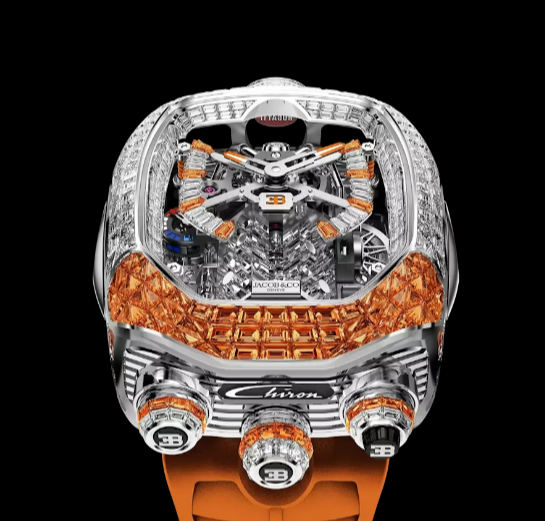
New Jacob & Co. Bugatti Chiron Tourbillon Watch

Unparalleled Luxury: The New Jacob & Co. Bugatti Chiron Tourbillon Watch Limited Edition

Imagine the feeling of Bugatti: precision, beauty, exceptional performance… all inextricably linked to the exhilarating power of the engines driving the world’s most advanced supercars. Launched in April 2020, the Jacob & Co. x Bugatti Chiron Tourbillon watch perfectly blends the core essence of the Bugatti brand, presenting the iconic 16-cylinder Bugatti engine in watch form for the first time. This timepiece showcases the artistry, dedication, and craftsmanship embodied in the Chiron 1. The release of four new limited-edition watches marks the pinnacle of automotive engineering and the ultimate collision of watchmaking artistry. The collaboration between Jacob & Co. and Bugatti continues, with more limited-edition Bugatti Chiron Tourbillon watches to be released.

The four new Chiron Tourbillon watches are exquisitely designed and crafted, perfectly embodying the essence of Bugatti. All models feature a breathtaking movement comprised of 578 components, seamlessly blending engine and watch design to create a stunning timepiece. Modeled after the engine block and scaled down proportionally, the movement is a true testament to the Bugatti 8.0-liter W16 engine. The engine’s dynamic animation can be admired through the expansive sapphire crystal. Furthermore, the watch houses a flying tourbillon movement tilted at 30 degrees. wholesale replica watches

The new Chiron Tourbillon watch utilizes new material choices for an ultimate personalized experience. Its design is inspired by the sleek lines of the Chiron sports car, perfectly complementing this stunning timepiece. The first model is crafted from a single piece of sapphire crystal, featuring a sapphire crystal case back, crown, and pushers, along with a rubber strap and titanium buckle. The second model, a limited edition, features an 18K rose gold case, a special anti-reflective sapphire crystal, an 18K rose gold transparent case back, and a black DLC-coated titanium crown and pushers adorned with the Bugatti logo. This watch features a rubber strap and a black DLC-coated titanium 18K rose gold buckle.

Another limited edition of 52 pieces features an 18K rose gold case set with dazzling white diamonds, an anti-reflective sapphire crystal, an 18K rose gold skeletonized case back, an 18K rose gold crown and pushers set with baguette-cut white diamonds—also engraved with the Bugatti logo—and a rubber strap with an 18K rose gold buckle adorned with white diamonds. Finally, there is a watch with an 18K white gold case set with 391 black and white diamonds (approximately 20 carats), a true epitome of luxury. The 18K white gold skeletonized case back complements the baguette-cut white diamond-set crown and pushers, and is paired with a rubber strap with an 18K white gold buckle adorned with 18 white diamonds (approximately 1.76 carats). replica watches for sale

A Bugatti Experience on Your Wrist – Jacob & Co. x Bugatti Chiron Tourbillon Limited Edition
Pressing the crown on the right side of the watch reveals the iconic Bugatti engine. Just like starting a supercar engine, the watch’s crankshaft (made of solid steel, one of the smallest and most complex components in watchmaking history) begins to turn, and the pistons move up and down accordingly. Their varying angles further enhance the watch’s complexity. A pair of turbochargers on either side of the engine block rotate with the power system, adding to the overall visual appeal.

The movement is secured by four miniature Chiron-style shock absorbers. In effect, the movement floats within the case, and its slight up-and-down movement can be observed. This floating design presented an additional challenge to the watch designers, who had to create and patent a unique, automotive-inspired lateral system to ensure the crown post was not damaged by the movement of the movement within the case.

The crown is located at the bottom of the case. The left crown is used for setting the time, the middle crown for winding the movement and chronograph function, providing a 60-hour power reserve, and pressing the right crown activates the chronograph function. The power reserve for the chronograph and chronograph functions are separate, but both are operated via the winding crown – clockwise rotation winds the movement (60 hours), and counter-clockwise rotation winds the chronograph (approximately three times). The side of the power reserve indicator even features the logo of a universal fuel pump.

As a fresh interpretation of a Bugatti classic, this fashion replica watch faithfully inherits the brand’s design DNA and conveys its rich emotion. In addition to the flying tourbillon adorned with the Jacob & Co. logo, Bugatti’s iconic “EB” logo is subtly placed inside the engine compartment, its “crankshaft” housing 16 pistons, poised for action. The tourbillon’s window design is inspired by the iconic horseshoe grille of Bugatti supercars.

In the world of watchmaking, the Jacob & Co. x Bugatti Chiron Tourbillon watch is the first to perfectly combine supercars with haute horlogerie craftsmanship. https://www.whereguidewatch.com

Unique – Patek Philippe: World Time

Since Patek Philippe fake reintroduced its World Time watch in 2000, the cult status of this complication has reached dizzying heights, as evidenced by watch auctions over the past 20 years. But it was the enamel and cloisonné enamel dials that made it to the auction block that really made the list. why is that? What makes them so special?

To truly understand this phenomenon, it is first necessary to realize that Patek Philippe produces fewer than 1,000 World Time watches a year. Of these, only 50 to 100 have enamel dials. In addition, there are few master enamels today, and even for them the process of making the dials of these enamel models is very rigorous. Let’s take a look at a brief history of enamel and its various applications.

While the earliest decorative enamel works are found on rings found in Cypress more than 1300 years before modern times (BC), our modern techniques handcrafted by major Geneva residents date back to the late 1700s and early 1800s . The market is expanding due to increasing interest in portable timepieces.

In its purest state, enamel is a powdered glass spread over a metal surface and fired in an oven at 1,380 to 1,560°F. When it melts at extreme heat, it liquefies, flowing outward to the edges of the surface. As it cools, it hardens into a smooth and very durable coating. For each layer or color, depending on the application used, continuous firing is required. Since the glass becomes liquid, it needs bezels to prevent it from spilling over the sides of the metal substrate. The two most common techniques are Champlevé and Cloisonné. fashion replica

Champlevé is a technique in which metal is carved quite deeply to form a pool or reservoir in which the enamel can be placed, which is then fired. If the guilloche works first, the artist may want to accentuate the guilloche work and therefore use a single or thinner fire. If it’s just a deep etched engraving, the artist will usually use multiple fires, which will make the color deeper and richer, just as a car enthusiast might apply 10 clear coats of flake paint, only to put the It is polished to 5 shimmering ultra clear coats.

Cloisonne, on the other hand, took the opposite approach. It starts with a flat surface, where the artist draws the basic outlines of the design features. The artist then takes the gold or silver wire and painstakingly places it on those same contours, carefully bending the wire to match the drawing. The result is walls that form clapboards or compartments (“cloisons” in French), in which the enamel is placed before firing. This is the most important point: no two descriptions are the same. The artist has a pattern, but only when examining two or more works side-by-side do small but perceptible differences from one work to the other emerge.

Enamel dial watches reached their heights of popularity in the post-World War II period from the 1940s to the early 1960s. Dial makers such as Stern Frères and Beyeler have produced various depicting artworks for Patek Philippe, Vacheron Constantin, Rolex and Omega. However, it is important to understand that these dial companies often have to outsource this type of work to local artisans,
Only a few of them are able to provide this level of service. By the 1970s, enamel dials had all but disappeared, and the industry had all but disappeared in the wake of the “quartz crisis.”

The history of Patek Philippe World Time watches is similar to their close collaboration with Louis Cottier, who developed this complication. A separate, longer article is required to delve into this history, so I’ll save it for another time. But after the death of Louis Cottier in the late 1960s, Patek Philippe eliminated the complication entirely. Thus, in 2000, Patek Philippe launched its first World Time watch in 35 years, the 5110, with a diameter of 37 mm and a new movement, the Calibre 240 HU (Universal Time or Universal Time).

The case has an A-shaped symmetrical design, and the crown guard protrudes smoothly to the outer rim of the crown to prevent impacts. However, watch lovers who know the history of Patek Philippe enamel dial World Time watches will need to wait another 6 years before the brand relaunches one of its most coveted and cherished dial designs.

In 2006, Patek Philippe introduced the 5130, a 39.5mm case housing the now-legendary 240 HU movement. Manufactured in the same style as the 5110, albeit with slightly longer lugs, this model is an instant welcome addition to the collection as taste in men’s watches is getting closer to the 40mm mark. With its slim round bezel, the 5130 is worn visually close enough to this evolving standard to meet the needs of many customers.

With the introduction of the 5130 in 2006, Patek Philippe also expanded by adding the 5131J (gold), a cloisonné enamel dial depicting an orbital view of the Atlantic Ocean, with the Americas on the left of the dial and Europe and Africa on the right. From the moment it was released, the model sold for two to three times its retail price on the secondary market due to very low production volumes. Since almost no one has produced dials of this type since the 1960s, there are no schools offering courses to train a new generation of watchmakers and dialmakers. It was passed down by artists who were willing to take apprentices, and even Patek Philippe had to hire local Geneva artists.

The 5131J is followed by the 5131G (white gold), which depicts a view of the Asian orbit centered on India, with Africa and Europe on the left, most of Asia at 12 o’clock, and Australia and East Asia on the right of the dial. This dial was followed by 5131R (rose gold), depicting a view of the Pacific Ocean with the Americas on the right and Asia and Australia on the left. All 3 variants are available on alligator leather straps with deployment clasp. The series concludes with the release of the 5131/1P (Platinum), depicting views of the Arctic ice sheets, with Asia and Europe on the right, and Greenland and North America on the left. Since the piece is on a platinum bracelet, the watch costs twice as much as any gold piece,

In 2016, Patek Philippe decided to completely redesign the case and delved into its extensive catalog to create the 5230, at the same time releasing the extension 5231J. Patek Philippe aims to differentiate it from its siblings in a number of ways, starting with its size. Noting the growing trend of Asian customers and Europeans towards smaller dress watches, the brand decided to reduce the World Time from its 39.5mm 5130 case size to a more elegant 38.5mm size. The difference, by itself, is almost imperceptible on the wrist. But more strikingly, Patek Philippe decided to ditch the crown guard in favor of a symmetrical case design. Another detail they changed, and one that the author likes, is that the lugs can flow off the case smoothly.

The 5321J was released with the now classic Atlantic orbital view, very similar to the 5131J, but with an arguably more colorful dial. Also, as mentioned, each dial is unique to each model, and even looking at the pictures of any particular model, you’ll notice that the lay of the gold line outlines and the color of the continent is slightly different.

Indeed, to own a piece of cloisonne enamel is to own a “one-of-a-kind piece,” which is why these pieces require a large investment from the initial buyer, and why they command such a high premium on the secondary market and at auction. When we look back at the enamel dials of the 1950s and ’60s, if history is any guide, these pieces invested in today will pay for a second home 30 to 40 years later, and why “you never really owned a Patek Philippe . You Just taking care of it for the next generation.” quality replica watches in store