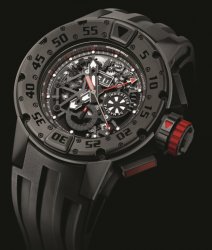

Devon fake: The Digital-Native Brand Where AI Meets Aerospace CNC
Devon calls itself a tech company, not a watch company. Its Tread 2 runs on microcontrollers and proprietary software, and its case requires 5-axis aerospace-grade CNC. Here is what a digital-native watch brand teaches about AI and design freedom.
Devon Works is the outlier in any series about AI and watchmaking, and that is precisely why it belongs here. Richard Mille built its data discipline inside a vertically integrated Swiss manufacture. Breitling built an enterprise data foundation across a certified industrial catalogue. Devon did something different: it began as a technology company that happened to make a watch.
The brand’s founder, Scott Devon, is explicit about this. Devon Works has a laboratory in Pasadena, California, and considers itself “a tech company, not necessarily a watch company,” closer in spirit to “a spin-off of Apple” than to a traditional maison. The Tread 2 is the product of that self-conception. It displays time not with hands but with four interwoven fibreglass-reinforced nylon belts—each roughly 2 microns thin—driven by micro-step motors and controlled by an onboard microcontroller running Devon’s proprietary software. A temperature-compensated crystal keeps the system to half a second per day. moon watch luxury
This is the third and final case in understanding where AI belongs in the watchmaking value chain : not as a tool imposed on a craft tradition, but as a native capability in a product whose core logic is computational before it is mechanical.
H2: When the Product Is a Control System, AI Has a Native Home
The Tread 2’s movement is not a conventional escapement. It is a small electromechanical control system: micro-step motors, an optical sensor that determines belt position, a wirelessly rechargeable battery, and a microcontroller that manages timing, chronograph, battery indication, and seconds mode through a lever-based crown system. The product is hybrid by design—battery-powered, software-mediated, and mechanically expressed.
That architecture matters for AI because it changes where intelligence can live. In a purely mechanical watch, the adjuster’s sensory judgment is the final feedback loop. In a digital-native watch, the control system is already generating state data: motor behaviour, belt position, timing corrections, battery condition. The same embedded logic that keeps the belts aligned is a data source for anomaly detection and long-term behaviour modelling.
Devon’s own materials describe the fashion swiss watch as “arguably the most cutting edge watch made today,” and the company’s engineering lineage runs through aerospace partners in California rather than through the Swiss craft supply chain. That lineage has a direct consequence for design. The Tread 2’s case—a 44mm tonneau form in 316L stainless steel, 14.5mm thick, weighing approximately 90 grams—requires 5-axis high-precision CNC machining of a kind more commonly associated with aerospace components than with watch cases. The design freedom to make a watch that looks like miniature factory equipment for the wrist depends on a manufacturing process that can execute geometries a traditional case-maker would not attempt.
This is the practical shape of AI-assisted design-space exploration in independent watchmaking : not an algorithm choosing the aesthetic, but a computational design environment in which a digital-native product can be iterated against manufacturing constraints before a single case is cut. The Tread 2 was not a derivative of the Tread 1; the redesign was driven by the founder’s fear that it “was in danger of being considered a derivative.” In a product defined by its mechanism rather than its dial, the design and engineering problems are inseparable—and that is exactly the condition under which simulation and constraint-based modelling earn their place.
H2: The Manufacturing Reality Check
The temptation in a digital-native story is to overstate the role of computation in the finished object. Devon’s own history is a useful corrective. When the company first approached Switzerland with the belt-display concept, the response was that it was “a crazy idea”—the price would be in the hundreds of thousands of dollars and the power reserve at most 30 seconds. The solution came not from Swiss horology but from an American aerospace partner that chose nylon and fibre composite similar to the material used in cockpit gauges. https://www.perfectwrist.co
That is a manufacturing lesson, not an AI lesson. The product became possible because the right process existed—5-axis aerospace CNC, advanced composites, embedded control—not because a model generated a design. AI’s contribution in a Devon-type context is downstream of that reality: simulating tolerances, ranking manufacturing risks, and reducing the iteration cost of a design that is already computationally conceived.
The industry evidence supports this division. Luxury watch brands use AI mainly for forecasting, quality control, and early design stages, while final assembly and decoration remain handcrafted; component makers invest in automation and AI for machining, engraving, gem-setting, and logistics. Devon sits at the independent extreme of that pattern: small enough that every design iteration is expensive, digital enough that AI-assisted simulation and process modelling can shorten the loop between concept and manufacturable part.
The more plausible AI future for Devon is not an AI-designed watch. It is a tighter feedback loop between a digital-native concept and the aerospace-grade manufacturing processes that make it real—so that the next Tread is not just a different set of belts, but a different set of possibilities that the process can actually deliver. best copy watches
H2: What Devon Closes in the Series
Richard Mille used data to protect repeatability at the edge of materials science. Breitling used a unified data foundation to protect certification and traceability at catalogue scale. Devon shows the third position: a brand whose product is computational from the start, and whose design freedom depends on the manufacturing processes that can execute what the computation proposes.
None of the three brands is racing to let AI design the watch. All three are building the data and simulation layers that determine whether the human decisions at the centre of the product are well-supported or exposed. The future of AI in high-end watchmaking is not a robot watchmaker. It is a more intelligent perimeter around human judgment—and the independent, digital-native brand is where that perimeter is thinnest, most visible, and most instructive.
The belts will still be assembled by human hands. But the hands will know more before they start.
FAQ
Does Devon use AI to design its watches?
There is no public evidence of AI-authored design at Devon. The brand describes itself as a technology company and uses embedded software and microcontrollers in the product, but design decisions remain human-led.
Why does Devon need aerospace-grade CNC for a watch?
The Tread 2’s belt-display architecture and tonneau case require 5-axis high-precision machining that is more common in aerospace manufacturing than in traditional watch case production. The process enables geometries a conventional watch case-maker would not attempt.
Is AI relevant to a digital-native watch brand?
Primarily in simulation, process modelling, and design-space exploration—reducing the iteration cost between a computational concept and a manufacturable part. AI does not replace the human decision about what the watch should be.